Fishing the North Coast 500
Experience some of the best fishing on the North Coast 500

The North Coast 500 winds through a treasure trove for the beginner and seasoned angler alike. On one side of the tarmac, you’ll find pristine highland rivers, alive with the rushing silver of salmon flowing into still loch surfaces, disturbed only by flirting flies and the bronze flashes of brown trout. Meanwhile on the other, vast blue depths hold schools of platinum mackerel moving over the golden silhouettes of pollock in the depths.
In this article, our guest blogger West Coast Fishing provides an overview of fishing on the route. West Coast Fishing started off as a few local anglers exploring the area and grew to become a professional and friendly team providing bespoke fishing experiences to anglers of all abilities. Read on to find out how you can get in on the action, whether you’re planning a fishing adventure or just considering giving it a go. This article will offer you a wealth of information and outlines the four core ways to fish on the North Coast 500 route: Bait fishing, Spinning, Fly Fishing for Pike and Fly Fishing for Trout and Salmon. All of the equipment mentioned in this blog can be bought at your local fishing shop or supplied with your West Coast Fishing booking.
Bait Fishing on the North Coast 500

Bait fishing is enjoyed across the country, from inner city canals to the most remote Highland Lochs, and you can take advantage of the full spectrum on the North Coast 500.
To get started on your fishing adventure, you will need a rod, reel with line, floats, weights, hooks and bait. Equipment specification will depend on which bait you are fishing with. In this blog we’ll introduce you to small baits and large baits.
Small Baits
Many anglers start out fishing small baits at their local water. Before long, the majority have explored their region, as it is a great way to fish on the go, requiring minimal equipment. Small bait fishing is fishing with worms or maggots and tends to catch small fish like perch, trout, roach and eel. West Coast Fishing recommends a light 7-9ft rod and size 3-4 reel with 12lb line. A small float and size 8-10 hook will complete your set-up. By swapping your float for a weight, you can fish from the bottom- this decision will depend on how deep, weedy and cold the location is.
Larger Baits
Fishing larger baits is an ideal way to target a bigger catch like pike and can also attract the occasional large trout or perch. The same principles apply and the best baits are oily fish like sardines, mackerel and sprat, or a bait natural to that water like eel or roach. You’ll need stronger equipment to cast heavier baits and land larger fish. West Coast Fishing recommends a 10-12ft baitcasting rod with a 3lb test curve and size 6-10 bait reel. The reel should hold a 40lb+ braided line. Instead of a single hook, use a ready prepared dead-bait trace. These feature a long length of wire trace with two treble hooks and can be found in most fishing shops. Pike tend to take prey head first so you’ll want to mount the bait facing away from the line end.
When fishing with weights, it is good practice to use rod stands and a low resistance drag. Bait reels, like bait runners, often have a secondary drag mechanism for when the bait is in the water. This mechanism allows the bait to be picked up by the fish almost freely but keeps the line taut for bite detection and hooking. As the line is moved by the fish, an additional bell or alarm can be used to alert the angler to a bite. There are numerous stand and bite alarm products on the market and they all help to minimise deep-hooking the fish or losing equipment. Familiarising yourself with any equipment you plan to take will help you to have the best time.
Bait Fishing Rules & Fees
Bait fishing is universal and the North Coast 500 offers a unique and rewarding experience for every skill level. When picking a water, be sure to get in touch with the estate manager who will talk you through any additional rules or fees – most waters require a small fee to help maintain the area. To make the most of your time on the route, get in touch with West Coast Fishing to design the perfect bait fishing experience, all equipment included.
Spinning
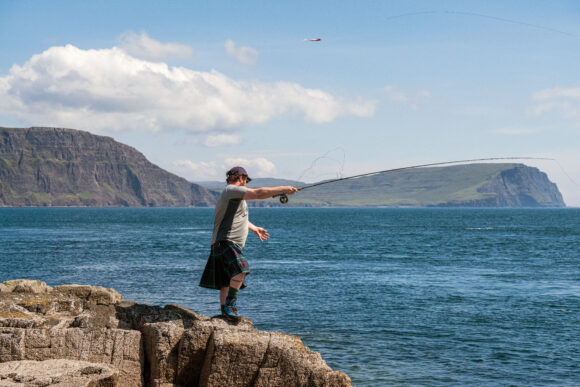
Spinning is one of the most popular and inexpensive ways to fish, making it an ideal technique for the North Coast 500. For a productive session, all you will need is: a spinning rod, reel with line, wire spinning traces (when fishing freshwater) and lures. West Coast Fishing recommends a light rod with casting weight of 10-40g and spinning reel lined with braided line of 20lb+ breaking strain.
Lures are designed to imitate prey in the water and come in a variety of materials, shapes, sizes and colours. As a result, there is a noisy market for lures and it is good practice to have a selection to use over the course of the session.
Freshwater Spinning
Freshwater spinning for Pike and Perch requires soft lures, bladed spinners, plugs and surface lures among many others. A 10+ inch wire trace between the line and lure will prevent the Pike’s sharp teeth from piercing the line.
Salmon and trout however, are attracted to large spoons, flying Cs and devon minnows.
Each type of lure will fish a certain way. Soft lures and spinners typically sink and a slow steady retrieve will kick off the flashy component, irresistible to predators. Plugs have a neutrally buoyant level, and surface lures float. Both require a degree of variation in the retrieve to sell the lure. A good rule of thumb is to fish deep and slow in cold conditions, and high and fast in the warmer weather. There is a lot of advice out there for when to fish some lures and not others but the best way is to get out and see what works for you.
For some extra guidance and all the gear, check out the West Coast Fishing website and get in touch to plan your spinning masterclass in the stunning Highlands.
Sea Spinning
Wander along any coastal walkway and the chances are you will meet somebody spinning over the rocks and kelp in search of some fish. The principles are the same as freshwater spinning, but with such a large area to cover, it is good to have some local insight. Especially since the NC500 offers some of the best mackerel, pollock, cod and coalfish waters in Europe.
The trick to spinning in the sea is to use shiny lures. Bronze and silver spoons are perfect as they imitate most native bait fish. Another popular lure is the feather rig, which will imitate a group of smaller bait fish or shrimp. Both should be fished in a steady jigging motion, where the lure is allowed a moment to sink then retrieved, and repeat.
To accommodate this jigging motion, seek out areas where deeper water (10m+) can be reached within casting distance. Then it is a matter of finding the depth that the fish are swimming at. This will depend on a number of factors, so a good starter is to count as the lure sinks. Start at 5s, then add some more time with each cast. The line flowing out from the reel will indicate that the lure is still sinking.
Line fishing is a much more sustainable way to source seafood than buying off the shelf and a great way to guarantee the freshest produce. West Coast Fishing offer half and full day sessions around Applecross and Lochalsh. At one of these session, you can expect a friendly and broad introduction to the tacklebox, demonstrations and help to optimise your cast, top tips for making the most of fishing that day, as well as guidance on cooking your catch.
Fly Fishing for Pike
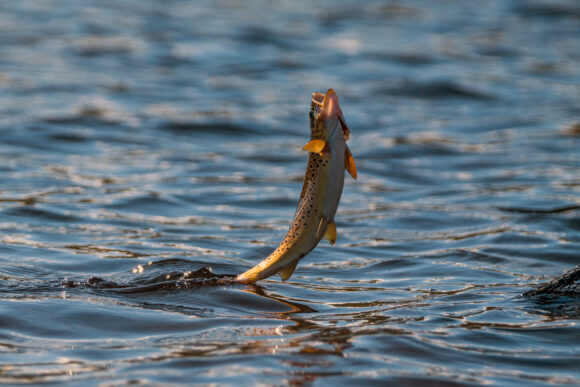
The pursuit for pike on the fly is taking off as the latest hit for anglers across the country. By the end of this section, you will know exactly what you need to experience the thrill of this apex predator’s signature strike.
Before delving into pike on the fly, let’s establish a few basics for fly fishing. This type of fishing requires a fly rod, reel and line, leader and tippet, and flies. The rod is an elastic arm that lifts and lays the line – beginners should use a floating line then explore intermediate and sinking lines after some experience. Both the rod and line are assigned a ‘weight’. Rod and line weights range from 1 to 15, where the same numbers should generally be fished together. 100m of 25lb+ line backing is also recommended. The number is indicative of the strength of the equipment. Leader and tippet are thinner sinking lines that help to send casting energy to the fly while remaining invisible to the fish. The fly is the lure and like spinning lures, can be presented in a variety of styles.
Pike flies are generally large and can be brightly or naturally coloured to represent a small fish or water mammal. A 9-11ft 8-10 weight rod is recommended to cast such flies. The reel only holds the line, so aim to get a reel that counterbalances the rod and can hold the recommended backing. From the end of the line, there should be a long leader with wire tippet – these can be bought pre-made.
A beginner’s session with West Coast Fishing will supply all the equipment and tuition required to get you on the right track to landing a highland pike.
Fly Fishing for Trout and Salmon
When planning to fish for trout and salmon, it is important to check that the dates you have in mind are in line with the fishing season- but don’t worry, this is really simple.
The UK brown trout season typically runs from 15th March to 6th October, but is subject to local rules, which can change each year. The best way to make sure you have the right to fish is to get in touch with the local fishing club or estate who can inform you of any additional rules and confirm season dates.
The salmon season is region dependent and is set by Fisheries Management Scotland. Since 2016, each region has also been given a conservation grade to indicate the health of the salmon stock in that river. Attached to each grade are some additional rules and all salmon caught before 1st April must be released. Roughly, the seasons across the NC500 start in mid-February and run to October. The latest seasons and conservation status can be found here: http://fms.scot/fishing-seasons/. Finally, it is important to sterilise equipment before fishing in Salmon waters to prevent the potential spread of parasites. The easiest ways to do this is to freeze lines and flies, and store the fly rod in a warm room for a couple of days.
What you will need
Trout on the fly is possible at many of the rivers, lochs and stocked fisheries on the route. Wild brown trout are typically smaller than stocked waters so a responsive rod and line around 4 or 5 fishing a small natural fly is ideal to enjoy the sport available. On larger or stocked waters, a 6 or 7 weight set-up will help to present larger flies.
When fly fishing for salmon, you’ll want a 13-14ft 8-10 weight fly rod and a reel which counterbalances the rod, holding lots of line. On the end of the line, you’ll want a 10ft leader of 18lb breaking strain. When choosing the fly, it is good to have a selection and to try out a few on the day to see what is working best. West Coast Fishing recommends larger brighter flies during the cool dark winter months and smaller, more natural-coloured flies in the bright summer.
If you are still a bit unsure about getting out there yourself or want to maximise your chances, with a team who know the area and will supply the equipment – check out the West Coast Fishing page.
Points to Remember
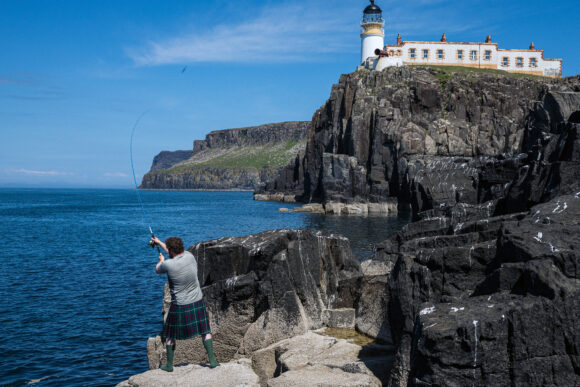
West Coast Fishing have unique access and knowledge of several freshwater water systems in the Applecross, Skye and Lochalsh region. To keep this and other areas fishing safely and productively, we recommend following the country code, seasons and permit rules at all times.
A landing mat, net and forceps will keep you and the fish safe when handling. Dress appropriately- it can be cold and wet on the route. It can also be very sunny, so always bring sunglasses and sunscreen to protect yourself from water glare. Sunglasses should be worn at all times while fly fishing.
It is important to use dead-bait that has been frozen to prevent the spreading aquatic diseases.
Flattening the barbed part of the hook is good practice for catch and release.
Lastly, fish with others if you are unsure about how to get set-up or where to go and always be careful around water – especially with the cold temperatures and strong currents on the route.
Tight Lines to you all!